Dear Echo Reader,
To keep you updated during the weeks when we work on our new issue, we started our newsletter, which you will receive weekly directly in your mailbox if you are subscribed; if not, you can access it via our website. Now let’s hear the first Echo of our newsletter.
Do you know how far back the history of evolution theory goes? Well, it actually stretches back to 610 BC. But who started this theory, which really helped us understand the world that we are living in and ourselves? The answer is kept inside an old philosophy book, probably forgotten inside your library.
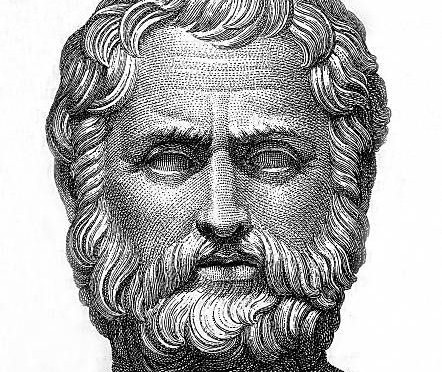
Anaximander
Anaximander. He was born in Ionia (located in İzmir-Aydın). As we may remember from our geography lessons, Ionia must be a harbour city. Anaximander was lucky to be one of the pupils of Thales (there was no record of it for sure, but as I am going to explain in the upcoming paragraphs, he was affected by the studies of Thales).
Like every student he had some disagreements with his teacher, such as; Thales argued that water was the source of everything (the beautiful sea that enchanted us must probably charmed them too) but Anaximender had another thought he thought that the source that gave everything life and created our world and more had to be something with no end not something concrete like arkhe but something that he called apeiron.
“From whatever things arise, to those things they return when they perish; for they pay penalty and retribution to one another for their injustice according to the ordering of time.”
The Cycle of Existence
Sadly, we do not have any written documents left from him, but he was the author of the first written Greek Philosophy document called Peri Physeos (On Nature). Here is the passage DK 12 A 10 (12 is the number given to Anaximender in Diels-Kranz system and A means its doxography): “He says that, at the coming-to-be of this world, something capable of generating the hot and the cold was separated off from the eternal, and that from this there grew around the air surrounding the earth a sphere of flame, like bark around a tree. When this sphere broke apart and became enclosed in certain circles, the sun, the moon, and the stars came into being.”
In this passage, the meaning of the separation of hot and cold meant the creation of Earth. He also argued that the Earth was at the center and the air surrounded it, and a flame also encircled them.
Another passage from Peri Physeos (It is a common term that most of the PreSocratic philosophers used to emphasize their methods on observing nature however we believe because the written document of Anaximander did not survive, the book of Anaximender had the name of On Nature) is mentioned in DK 12 B 1.
As we see in the passage, he argues that everything must come to its source of creation. It is evidence that helps us understand the way he sees the world within the cycle of existence and the inevitable return to the source or aperion. Also, the “pay penalty” part shows us that the inequalities in the world shall become equal.
An Early Idea of Evolution
If we analyze the usage of “injustice,” it does not mean the injustice between people but inequality between cosmic powers. It still amazes me that he referred to the word injustice to the inequality in nature. He points out that everything happens in order of time, and he connects the cycle to time, not time to the cycle. It might be confusing to understand the difference at first, but we can say that he uses time as a triangulation point.
As I mentioned in the beginning, we believe that he was the first person to argue that humankind sprang up from water creatures. But we can not be sure if he was the first person ever to propose the idea that humankind's source was the sea world.
Yet the thing that makes him special is that (as we know from fragments) he wrote the first written document in the history of Presocratic philosophy.
For more research, you can read the work of Charles H. Kahn, “Anaximander and the Origins of Greek Cosmology,” for a deeper dive into the topic, which also helped me a lot, and I would highly recommend reading the first book of the History of Philosophy by Umberto Eco.
This was all from our weekly newsletter; keep checking your email inbox so you don't miss anything. See you next week, and do not forget to check our Instagram account.